The following diary was loaned to the society by the late Donald Goldsmith.
In the transcription we have attempted to follow as closely as possible the wording and grammar of the author.
OLD ORMSKIRK
Memories of sixty to seventy years ago (Written in 1942)
By John Tyrer
A descriptive picture of its streets, etc.
It will not be uninteresting to those whose lot has been cast to reside in or around Ormskirk, or to have received their births in this ancient town if we survey the various changes which have taken place. This period dates before the advent of the bus and motor services.
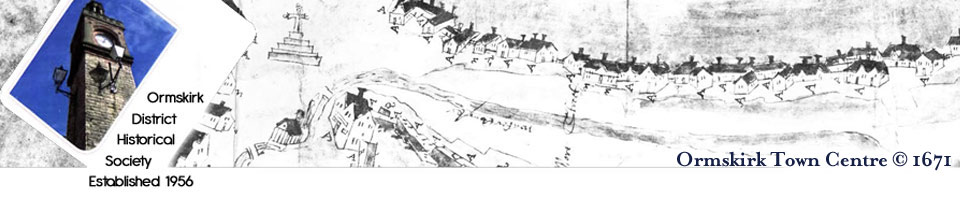
It would be well if we cast our minds back to the appearance of the centre of the town at that time. Standing at the market cross, on the spot where the clock tower now is, there stood an obelisk, with its large lamp at the top of the post, and its circular drinking fountain constantly in use for the services of man and beast, in those days their where a few dairies in the town and in the late afternoon the cows where brought from the fields where they had been grazing and sometimes halted for a drink at the fountain. We must remember that there was not the traffic in the streets that there is today.
The writer can remember one of the butchers in the town who went to Liverpool to purchase his cattle and sheep-usually on a Monday-taking with him his well trained sheepdog, he would drive his cattle and sheep through the busiest parts of Liverpool and then leave the dog in charge to bring the cattle and sheep to Ormskirk, he himself travelling by train, would meet the drove when they were near home.
In the year 1876 the obelisk was removed to the corner of Chapel Street (the site of the Beaconsfield Statue) where it was allowed to remain until the year 1884 when it was again removed to afford space for the statue as above stated; afterwards it was given a position within the enclosure of shrubs within the railings in front of the present Drill Hall.
Let us now return to the centre of town and view the changes which have taken place in Aughton Street
Aughton Street
Viewing the eastern side the first of the business premises was a drapers shop which was occupied by Mr. J. Robinson, and was entered by proceeding up three or four steps, the window being a small bay with squares of glass about 15”x12” Mr. James Mawdsley was the occupier of the next shop he being the grand father of the present tenant.
Next there was the Fleece Hotel, the owner being Mr. J Bradshaw who kept a number of horses and vehicles and catered for weddings and funerals. There also was Slaters watch and clock maker An ironmonger owned by a person named Mr.Edgar who catered for the farming community came next. After this there was a fish shop which at one time was owned by Mr.Iddon father of Mr. James Iddon of Scarisbrick Street, in front of this shop stood the old fish-stones, where dealers in fish attended on market days to dispose of their commodities. The “White Bull” public house was the next dwelling, then came the earthenware establishment of Mr. Lee the father of the present proprietor a small wares shop owned by Mr. Burrows came next then Mr. Williams the tailor who I think afterwards removed across the street and where the post office now stands were the premises of a vetinary surgeon named Brown. After this there was Glovers Cabinet making business on the premises now occupied by Miss Caves confectioners the proprietor also did an extensive business in the manufacturing of brooms. Up the yard next to this shop there lived a man named Berkely who controlled a large poultry and pigeon business. He had a pony and trap with which he scoured the countryside in his pursuit of poultry etc…After came the tailors shop of Mr. Thomas Swift who I believe specialized in the making of corsets. A little further down the street was Miss Winrows shop where materials for cobblers were supplied such as nails and rivets as well as tools etc.Next we come to the Boys School which had been newly built this would be sixty-eight or sixty-nine years ago. The boys at this time had transferred from the Charity School in Derby Street the Girls and Infants staying in the Derby Street School. There were next two or three cottages which were used as small shops for the sale of sweets etc…There next was a court where lived a butcher named Birchall who traded in cattle. We now come to a few more dwelling houses which were entered by the usual stone steps, the tenants of some having small businesses such as shoe making and repair work etc.We now come to Troqueer Buildings which in these days is the headquarters of the Parliamentary Labour Party. We now come to the business premises of the famous nurseryman Mr. Brown whose grounds extended for some distance behind the premises, some cottage property next came in view which has long since been demolished. It was near this part of the street where there stood the Public House styled “Black Horse” and not far away a Beerhouse called “St Patrick” which was between the “Black Horse” and the “Queens Hotel” which is still there, behind this hotel is a brewery which has been out of use for a long while. There were four cottages just past the “Queens Hotel” and a dwelling house with an off license for the sale of beers. We now come to a yard which was the entrance to a rope walk which was owned by the ancestors of the late Mr. John Ball of the Iron founders in Church Street. We then pass two or three workman’s dwelling houses and then came the”Forresters Arms”, this beerhouse stood in the centre of a row of houses which reached to the entrance to Treacle Row. having crossed the bottom of Treacle Row we come to Peter Rawsthornes beerhouse and a few cottages which reached to the corner of Dyers Lane and to the brook or boundary of Ormskirk., and I may say that just beyond the brook at the point which divides the two roads into Aughton Liverpool Road and Prescot Road there stood the brewery of Mr. Parker
We will now retrace our steps to the Market Cross and view Aughton Street on the other side commencing from the corner of Church Street. At the corner there was the Post Office which was run in connection with the grocery business of Mr. R Wignall a large teapot hanging over the shop door. I believe that this site had previously been occupied by the “George and Dragon” public house. Williams’s tailors shop came next; this was by Lamberts ironmongery business. This business was followed up by the late Mr.J.J.Balmforth who I believe was a nephew of Mr.Lambert.We now come to Garside’s shop which was controlled by the late Mr.Garsides father. From about this part of the western side of Aughton Street there has been considerable alterations and improvements. The Talbot Hotel was only a small yellow washed Inn which was entered by two or three stone steps, by which you went down into the house. Then came Chisnalls drapery premises, then John Peets small ware and general shop. I think the “Black Bull” beerhouse was located near to this point and a butcher’s shop close by. Next there was a yard in which there lived a man who went by the name of “Mug George” from the fact that he sold crockery and chalk moulds. At the time he kept one or two donkeys for business. We now come to the “Star Vaults beerhouse. About here were one or two lodging houses and a painter and paper hangers shop close by, with the “Navvies Home” beerhouse in the vicinity. There was also a public house not far away from the beerhouse before reaching the end of Derbyshire’s yard. This yard had a beerhouse on each side, and then there were one or two small shops. Near these premises was an opening leading to the Unitarian Chapel the minister being The Rev J.Fogg, he was a sociable old gentleman with a deep sense of humor who used to indulge in the writing of original humorous paragraphs for the local newspaper, at this point it will not be uninteresting if I give a copy of a poem he wrote over seventy years ago
Paddy’s farewell to Ormskirk.
Oh fare thee well old Ormskirk
To leave thee my heart dear doth ache well
from Carrig-Furgus to Cape Clear
we never see thy equal.
For though to foreign parts were bound
Where cannibals may eat us
We’ll ne’er forget the holy ground
Of gingerbread and potatoes
Oh fare the well thou old Moss Mill
Whose prospects take my fancy
Oh fare thee well thou Devils Wall
Where oft I’ve walked with Nancy
Oh fare thee well thou fine old church
With thy tower and pointed steeple
Thy merry bells do oft-times ring
To plague the Ormskirk people
Oh fare thee well thou water tower
Whose water makes me frisky
Though not when take by itself
But when it’s mixed with whiskey
Oh fare thee well old Bath Wood
And ever flowing fountains
Oh fare thee well thou Ladies Walk
And Cockolorum Mountain
When good St.Patrick banished frogs
And shook thee from his garment
He little thought he’d go abroad
To live upon such rich varmint.
And leave the place where potatoes grow
To wear the victors buttons
With vinegar for mountain dew
And toads for mountain mutton
We have already passed what is now called Park Road which did not exist at the time of which I am writing. But if I mistake not Old Mrs.Melia’s fish shop was somewhere in this vicinity, this old lady was the mother of the Rev.J.Melia a Roman Catholic priest, she had two sons James and Pat. these are all deceased. There was also a tinsmiths shop near owned by a Mr. Davenport who also sold lamps and paraffin oil. We now pick up the thread after reaching the Unitarian Chapel entrance. We now come to two or three small shops when there appears another beerhouse “Robin Hood”. There was next a few small houses with cottagers living behind who were mostly Irish labourers’ and these gained access to there homes through narrow passages or courts, after these there was the “Bulls Head”Public house.
We now come to the Ormskirk Gas Works, a few cottages are now seen and two beerhouses which were kept by Anthony Lunt and Abraham Whittle these were passed before reaching the “Greyhound Hotel”. We now come to the leather shop owned by Mr. Bond, a few more cottages followed then came the barn by the brook. This was used for threshing corn by hand. I have seen men working and swinging the flail round to knock out the corn; this was a long piece of wood which formed the handle and a shorter piece attached to one end worked as if on a swivel in that it would move about in any direction quite loosely. This brings us now to the end of the street which contained of as many public houses and beerhouses that exist in the whole of Ormskirk at this time 1942.
One might be tempted to ask the reason of so many drinking places in these olden days; I would suggest that seeing that beer was the national beverage less than 300 years before this time and that tea and coffee had only just been imported into this country-the price being beyond the dreams of the labouring classes, until eventually the prices came down so that it was possible for the workers to obtain a little. Not many years before my lifetime the price of tea amounted to about seven or eight shillings a pound. There were no tea rooms or restaurants in those days in a town like this, with a population of not more than 5000 people. Families then had beer to their meals hence there were so many places to obtain it, but as the price and popularity of tea came reasonable the consumption of beer consequently decreased.